Playing · Auto-bet
Dice auto-bet: the settings that decide how a session ends
Auto-bet can place hundreds of dice bets a minute. Set up well, it is the best limit tool on the screen; set up badly, it is the fastest way to empty a balance. Here is every setting, what it does and three safe presets.
Every serious crypto dice game has an auto-bet tab, and it is the most powerful control on the screen. It places bets for you, adjusts the stake by rules and stops when a condition is met. The difference between a safe dice auto-bet session and a disastrous one is usually one empty field. This page explains each setting and gives three presets you can copy.
The settings, one by one
| Setting | What it does | Recommended |
|---|---|---|
| Number of bets | Stops after this many rolls (0 often means “no limit”) | Always set a number |
| On win | Reset, increase or decrease the stake after a win | Reset |
| On loss | Reset, increase or decrease the stake after a loss | Reset |
| Stop on profit | Ends the session when net profit reaches this amount | Set it |
| Stop on loss | Ends the session when net loss reaches this amount | Set it first |
| Max bet | Caps the stake if on-win/on-loss rules push it up | Set it if you use increases |
| Speed | How fast bets are placed | Slowest available |
Names vary slightly by site, and some games put stop on loss under “advanced”. Look for it before your first auto session.
Stop on loss: fill this in first
Stop on loss is the setting that makes auto-bet safe. It watches your net result for the session and ends it when the loss reaches your number. Set it to an amount you can lose without it bothering you tomorrow. For a 100 USDT balance, 20 or 25 USDT is a sensible session cap.
Two details matter:
- It measures net loss for the session, not a single bet. A session that goes up 30 and then down 50 has a net loss of 20.
- It checks after each bet. If your stake is large compared with the stop, the last bet can overshoot it. Keep stakes small relative to the stop.
Stop on profit: the underrated one
Most players leave stop on profit empty because they do not want to “limit their wins”. But the house edge applies to every roll, so a session that keeps going after a good run gives more and more of it back on average. A profit stop turns a good run into a finished result. A stop at 20–30% of the session budget is a reasonable place to start.
On win and on loss: where systems live
The on-win and on-loss rules are how auto-bet runs betting systems:
- Reset on both: flat betting. The most predictable option.
- Increase on loss by 100%, reset on win: Martingale. High chance of a small win, low chance of a large loss.
- Increase on win by 100%, reset on loss: reverse Martingale or Paroli-style. Many small losses, rare runs of wins.
- Small percentage increases: gentler versions of the above, with the same average cost.
None of them changes the house edge. They change the size and frequency of wins and losses. Before you use any of them, look at the numbers in crypto dice strategy.
Speed is a risk setting
Auto-bet at full speed can place several bets a second. At 1 USDT a roll and a 1% edge, each thousand rolls costs about 10 USDT on average, and a thousand rolls can take only a few minutes. Slower speed does not change the odds, but it gives you time to notice what is happening. If your game has a speed setting, use the slowest one.
Three safe presets
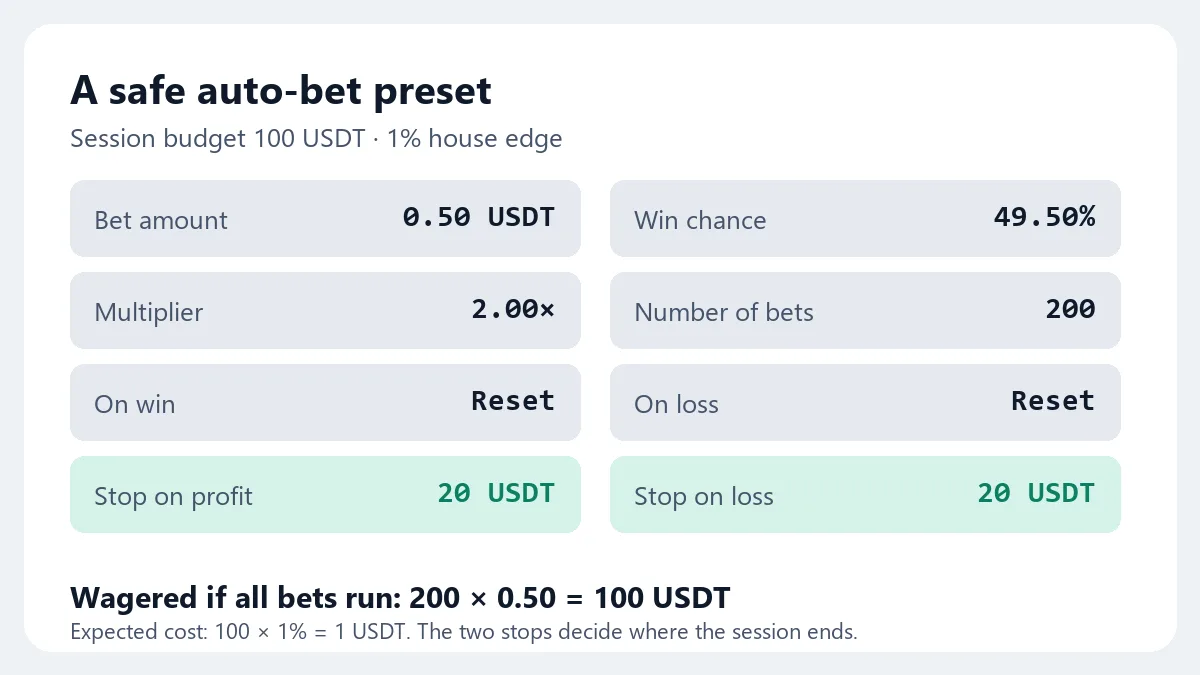
These presets assume a session budget of 100 USDT at a 1% edge. Scale the numbers to your own budget.
1. Steady flat session
- Stake: 0.50 USDT
- Win chance: 49.5% (2.00×)
- Number of bets: 200
- On win / on loss: reset
- Stop on profit: 20 USDT
- Stop on loss: 20 USDT
- Total wagered if all 200 bets run: 100 USDT; expected cost about 1 USDT
2. Low-volatility grind
- Stake: 1 USDT
- Win chance: 75% (1.32×)
- Number of bets: 150
- On win / on loss: reset
- Stop on profit: 15 USDT
- Stop on loss: 15 USDT
- Total wagered if all bets run: 150 USDT; expected cost about 1.50 USDT
3. Long-shot hunt
- Stake: 0.20 USDT
- Win chance: 10% (9.90×)
- Number of bets: 250
- On win / on loss: reset
- Stop on profit: 25 USDT
- Stop on loss: 25 USDT
- Total wagered if all bets run: 50 USDT; expected cost about 0.50 USDT. Expect long runs without a win.
The win chances and multipliers above come from the table on the dice odds calculator page.

Settings to avoid
- Number of bets set to 0 (infinite) with no stop on loss. The session only ends when the balance does.
- Increase on loss of 100% without a max bet. Ten losses turn a 1 USDT stake into a 1,024 USDT bet.
- Resetting stops mid-session. If a stop triggered, the session is over. Starting again with new stops is the same session with a bigger loss.
- Running auto-bet with a bonus active without checking the bonus terms. Many bonuses cap the stake or exclude dice; an auto session can break the terms in seconds.
Auto-bet and provably fair
Auto bets are ordinary bets: each uses the next nonce and can be verified after you rotate the seed pair. If you run long auto sessions, check a few rolls from the middle of the session afterwards. The steps are in provably fair dice.
Check the auto-bet panel first
In-house dice games on the sites in our crypto dice games ranking come with an auto-bet tab. Before you rely on one, open it and confirm it has both stop on profit and stop on loss; if a game offers only a number of bets, keep sessions short and run them manually.
Use it as a brake
Auto-bet is best used as a brake, not an accelerator: a way to make sure a session ends where you decided it should. Set deposit limits in your casino account as well, take breaks, and never chase losses. Gambling is for adults over 18; if it stops being fun, free and confidential help is available from Gamblers Anonymous and GamCare.