Playing · Dice family
Dice gambling games: crypto dice, craps, sic bo and the rest
Crypto dice is one member of a large family of dice gambling games. Craps, sic bo, chuck-a-luck and dice duels all turn on a roll, but their house edges run from about 1% to over 16%. Here is how each one works and which bets are cheapest.
People have gambled on dice for thousands of years, and casinos still carry a whole family of dice gambling games. They share a random roll and not much else: some use one number from 0 to 100, some two dice, some three, and their house edges differ more than most players realise. This page runs through the ones you will meet in a crypto casino and shows where the cheap bets are.
The house edge across dice gambling games
| Game and bet | Dice | House edge |
|---|---|---|
| Crypto dice (in-house) | One number, 0–100 | about 1% |
| Craps: don't pass | Two | about 1.36% |
| Craps: pass line | Two | about 1.41% |
| Craps: place 6 or 8 | Two | about 1.52% |
| Sic bo: big or small | Three | about 2.78% |
| Craps: field (12 pays triple) | Two | about 2.78% |
| Craps: field (12 pays double) | Two | about 5.56% |
| Chuck-a-luck: single number | Three | about 7.87% |
| Sic bo: any triple (30 to 1) | Three | about 13.9% |
| Sic bo: specific triple (180 to 1) | Three | about 16.2% |
| Craps: any seven | Two | about 16.67% |
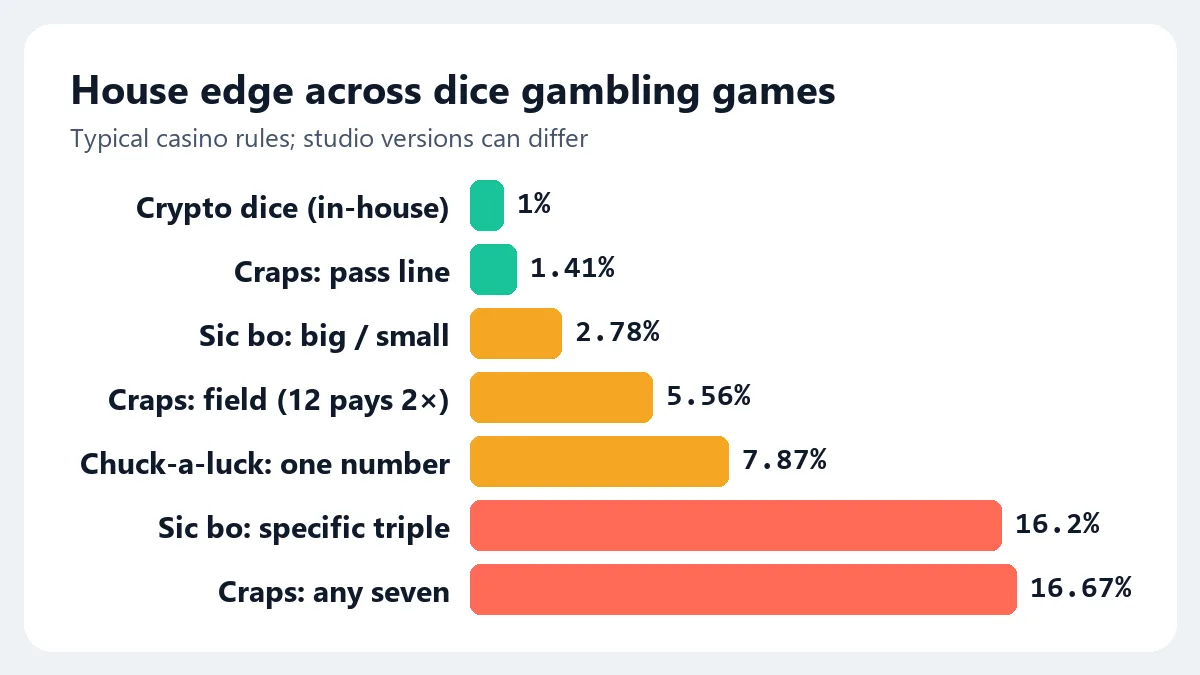
The pattern is the same in every game: simple even-money bets are cheap, long-shot bets on exact results are expensive. Studio versions can use different pay tables, so check the game's own rules before you compare.
Crypto dice
Crypto dice replaces physical dice with a random number from 0.00 to 99.99. You choose a target and bet on the roll landing under or over it. The payout follows from the win chance and the edge, usually 1%: a 50% chance pays 1.98×, a 10% chance 9.90×. Its strengths are the low edge, the freedom to set any win chance, and provable fairness on in-house versions. Its weakness is speed: it is easy to wager a lot in a short time.
We explain the mechanics in how crypto dice works and rate the sites that run it in our crypto dice games ranking.

Craps
Craps is the classic two-dice casino game. A round starts with the come-out roll:
- Pass line wins on 7 or 11, loses on 2, 3 or 12. Any other total becomes the point; the shooter keeps rolling, and pass wins if the point comes again before a 7.
- Don't pass is the reverse, with 12 on the come-out roll as a tie.
These two bets are among the cheapest in any casino, around 1.4%. Craps also offers odds bets behind the line that pay true odds with no edge at all, which is why experienced players put more money behind the line than on it. The expensive part of the table is the centre: proposition bets such as any seven or specific totals carry edges above 10%.
At crypto casinos, craps appears as a live-dealer game or a digital studio game rather than a provably fair original.
Sic bo
Sic bo uses three dice and a table of betting areas. The simplest bets are:
- Small: total of 4 to 10, excluding triples. Pays 1 to 1.
- Big: total of 11 to 17, excluding triples. Pays 1 to 1.
Both carry about a 2.78% edge because triples, 6 of the 216 possible results, make them lose. Everything else on the sic bo table, specific totals, doubles, triples and combinations, is a long shot with a higher edge. A specific triple usually pays 180 to 1 against true odds of 215 to 1.
Sic bo is common in live casino lobbies at crypto sites, often in a lightning or multiplier version that changes the pay table. Read those rules closely; boosted multipliers usually come with lower base payouts.
Chuck-a-luck
Chuck-a-luck is the ancestor of sic bo: three dice in a cage, and you bet on a number from 1 to 6. You win 1 to 1 if the number appears once, 2 to 1 twice and 3 to 1 three times. It looks close to fair, since each die has a one-in-six chance, but the edge is about 7.87%. It is a good example of how a game can feel generous while charging several times more than crypto dice.
Hi-lo dice and dice duels
Many crypto casinos and studios run simpler dice games:
- Hi-lo dice: guess whether the next roll will be higher or lower than the last. Payouts shrink as the obvious guess gets more likely.
- Dice duels: you and the dealer or another player each roll; the higher total wins. Ties go to the house or push, depending on the rules.
- Dice-themed slots: slots with dice symbols instead of fruit. These are slots, with slot RTPs, and nothing like the dice games above.
Always open the info panel. Games in this group have no standard edge, so the stated RTP is the only number worth comparing.
Which dice gambling game to pick
- For the lowest cost per bet: crypto dice at 1%, or the craps pass and don't pass lines at about 1.4%.
- For something to verify yourself: in-house crypto dice, because it is provably fair. See provably fair dice.
- For a live table: craps or sic bo with a dealer, sticking to the simple bets.
- To avoid: proposition bets, specific triples and anything that pays huge odds on a single exact result.
The same limits apply
Whatever the dice gambling game, the edge applies to every bet, and a faster game means more bets per hour. Set a budget before you start, play the cheapest bets, and stop when the budget is spent. The numbers for crypto dice targets are on the dice odds calculator page. Gambling is for adults over 18; free, confidential help is available from Gamblers Anonymous and GamCare.