The game · Mechanics
How crypto dice works: the roll, the target and the payout maths
A crypto dice game rolls a number from 0 to 100 and pays you if it lands on your side of a line you choose. Here is where the number comes from, how the payout is set and what every field on the dice screen means.
Crypto dice looks like a toy: a bar, a slider and a button. Underneath it is a small piece of arithmetic that is the same on every site, and once you understand it you can read any dice game in seconds. This page explains how crypto dice works from the roll itself to the number on the payout button, so the choices on the screen stop being guesses.
The roll: a number from 0 to 100
Every crypto dice game produces one number per bet, usually shown with two decimals: 0.00 to 99.99, or 0 to 100 depending on the site. The number is not drawn from a physical die. It is calculated from three inputs:
- The server seed, a random string the casino generates and keeps secret until you change seeds. Before you bet, you see only its hash, a fingerprint that locks the casino in.
- The client seed, a string you can set yourself. Change it and every future roll changes with it.
- The nonce, a counter that starts at 0 and goes up by one with every bet you place on that seed pair.
The game combines the three with a cryptographic hash function, usually HMAC-SHA256, and turns the first part of the result into a number in the dice range. Because the server seed is fixed before you bet and the nonce is known, the same three inputs always give the same roll. That is what lets you check the game afterwards; our guide to provably fair dice shows the calculation.
The target and the direction
Before each roll you set a line on the bar, the target, and choose a side:
- Roll under wins when the result is below the target. Roll under 25.00 wins on 0.00 to 24.99.
- Roll over wins when the result is above the target. Roll over 75.00 wins on 75.01 to 99.99, or from 75.00 on some sites, which is why it is worth reading the exact boundary rule in the game's help panel.
The direction makes no difference to your odds. Roll under 25 and roll over 75 each cover a quarter of the range and pay the same. Some players flip the direction to “feel” a change of luck; the numbers do not care.
Win chance and multiplier
The part of the range on your side of the target is your win chance. The game then sets the multiplier, what a winning bet returns including your stake, from one formula:
multiplier = (100 − house edge) ÷ win chance
With the common 1% house edge:
| Target | Win chance | Multiplier |
|---|---|---|
| Roll under 98.00 | 98% | 1.0102× |
| Roll under 80.00 | 80% | 1.2375× |
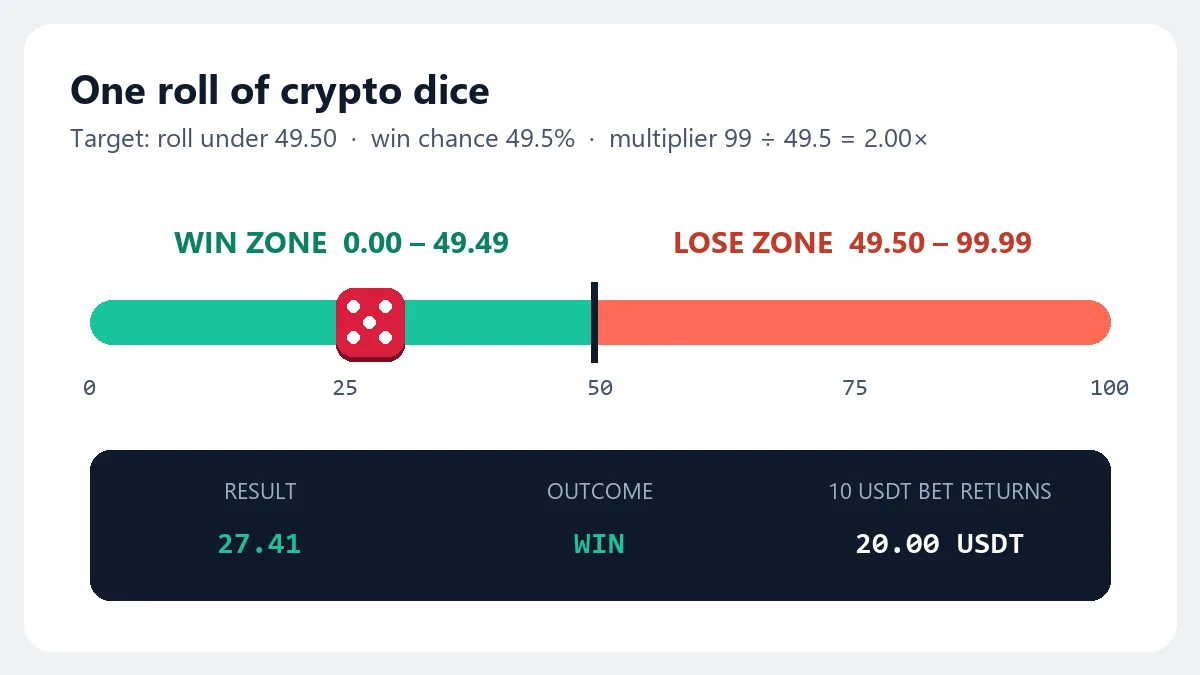
| Roll under 49.50 | 49.5% | 2.00× |
| Roll under 33.00 | 33% | 3.00× |
| Roll under 19.80 | 19.8% | 5.00× |
| Roll under 9.90 | 9.9% | 10.00× |
| Roll under 0.99 | 0.99% | 100.00× |
Most dice screens let you edit any of the three fields, target, win chance or multiplier, and recalculate the other two. If you know the payout you want, type the multiplier; if you know how often you want to win, type the chance. For any value not in the table, use our dice odds calculator page.

Where the house edge hides
A fair coin flip at 50% would pay exactly 2×. Crypto dice pays 1.98× for the same chance. The casino does not skew the roll; it shortens the payout. That is the whole business model, and it is the same for every target:
- Bet 10 USDT at 49.5% for 2.00×. On average you win 49.5% of the time and receive 20 USDT, so the expected return is 9.90 USDT.
- Bet 10 USDT at 9.9% for 10.00×. On average you win 9.9% of the time and receive 100 USDT, so the expected return is again 9.90 USDT.
In both cases 0.10 USDT per bet, 1%, stays with the casino on average. The target changes the swings, not the price.
Originals and provider dice work differently
Everything above describes in-house dice, the originals built by crypto casinos themselves. It is also how the games of the sites in our crypto dice games ranking behave: Stake Dice, the dice of Bitsler, DuckDice, Shuffle, BetFury, Rainbet and others.
Dice games from outside studios are a different product. They often look like slots, with reels or boards drawn as dice, and their return is set by the studio and certified by a lab. They do not usually let you set a target, and their RTP may be well below 99%. Read the info panel before you treat them as the same game.
The fields on a typical dice screen
| Field | What it does |
|---|---|
| Bet amount | Your stake per roll, in the coin of your balance |
| ½ and 2× buttons | Halve or double the stake |
| Target / slider | The line on the bar |
| Roll over / under switch | Which side of the line wins |
| Win chance | Your odds of winning this roll, in % |
| Multiplier | What a win pays, stake included |
| Profit on win | Stake × multiplier − stake |
| Manual / Auto tabs | One roll per click, or a series by rules |
| Fairness | Seeds, nonce and the verify link |
The Auto tab is where sessions go right or wrong. It lets you set the number of bets, stop on profit, stop on loss and what happens to the stake after a win or a loss. We explain each setting in dice auto-bet.
A roll from start to finish
Here is one bet, step by step, as it happens on a provably fair game:
- You see the hash of the current server seed and your client seed. The nonce is 41, because you have made 41 bets on this pair.
- You set 5 USDT, roll under 49.50, for a 2.00× multiplier.
- You press Roll. The game hashes server seed, client seed and nonce 41, turns the result into a number and gets 27.41.
- 27.41 is under 49.50, so you win: 10 USDT back, 5 USDT profit.
- The nonce moves to 42. The server seed stays secret until you rotate the pair; then you can check that roll 41 really was 27.41.
Common misunderstandings
- ”The game is due a win.” It is not. Each roll uses a new nonce and is independent of the last.
- ”High multipliers have a worse edge.” On a correctly built dice game, every target has the same edge.
- ”Changing my client seed changes my luck.” It changes which rolls you get, not their odds. It is still worth doing, because it proves the casino could not have prepared a sequence for you.
- ”Roll over is luckier on this site.” No direction is luckier. If you ever find one that is, you have found a broken game and should stop.
What to do with this
Knowing how crypto dice works tells you what you can and cannot control. You control the stake, the win chance and the number of rolls. You do not control the average. The best use of the mechanics is therefore to choose a win chance whose swings you are comfortable with, set a total you are willing to wager, and stop there. If you want to test systems anyway, read the numbers first in crypto dice strategy.
Play within limits
Dice is fast, and fast games make losses add up without you noticing. Set a deposit limit in your account, keep sessions short and never raise your stake to recover a loss. Gambling is for adults over 18; if it stops being fun, stop, and talk to Gamblers Anonymous or GamCare, both free and confidential.